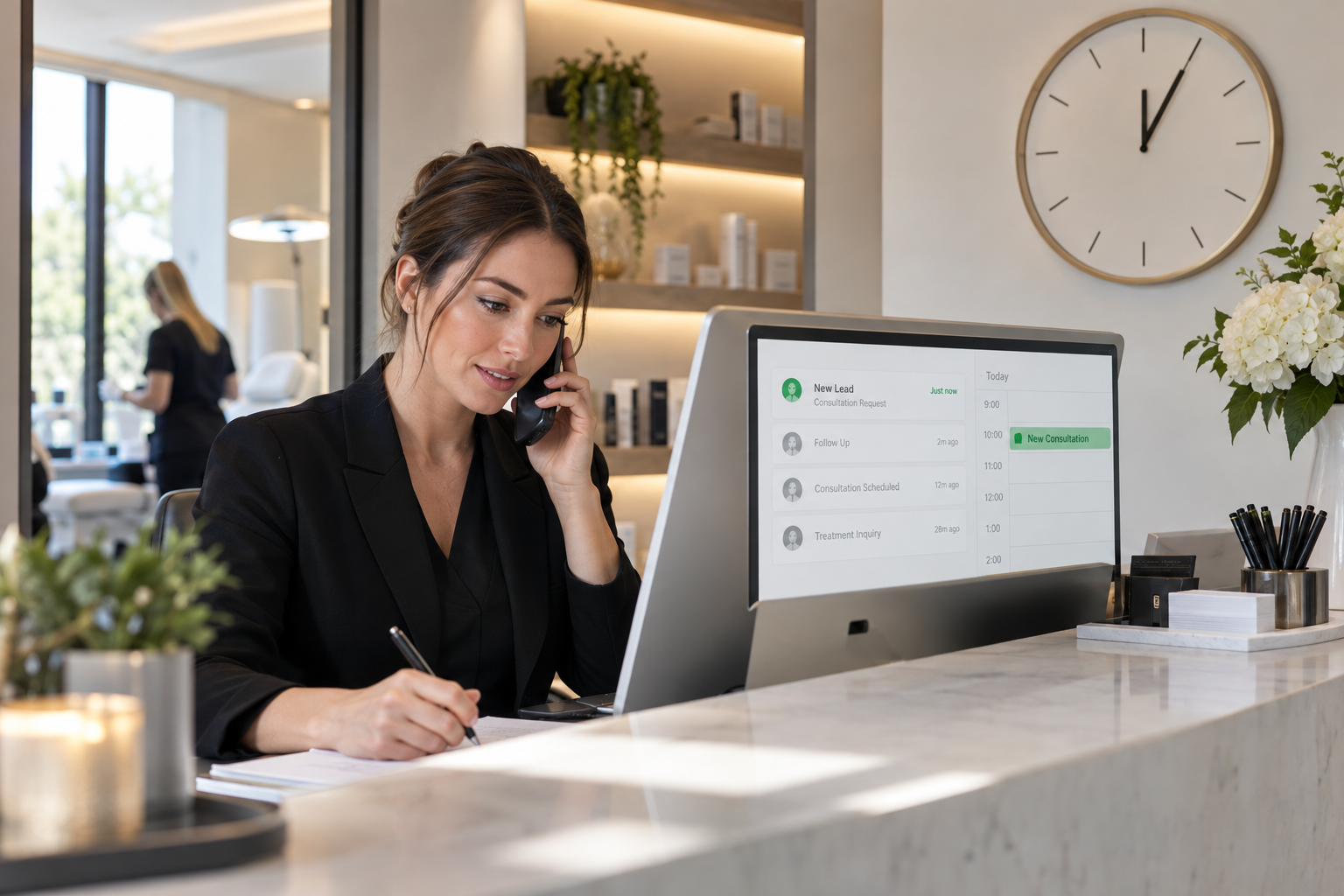
A prospective patient sees your Botox offer, submits a form, and waits. If your team does not respond promptly, that person may contact another practice, get distracted, or lose the motivation to book. That is the practical challenge behind med spa speed to lead: turning interest into a real conversation while the treatment is still top of mind.
The first five minutes should not be treated as a magical cutoff or a guarantee of conversion. It is a useful operational benchmark. It encourages your practice to acknowledge inquiries immediately, create a clear next step, and prevent valuable leads from sitting unnoticed in an inbox.
What Med Spa Speed to Lead Actually Means
Speed to lead is the time between a prospect taking an identifiable action and your practice beginning a meaningful response. The action could be submitting a consultation request, responding to an Instagram promotion, calling after business hours, or asking about a treatment through website chat.
A meaningful response does more than send a generic message saying, “We received your inquiry.” It confirms the person’s interest, offers a useful next step, and makes it easy to continue the conversation. Depending on the inquiry, that next step might be booking a consultation, answering a basic logistical question, or transferring the lead to a trained coordinator.
A well-designed Medspa growth system connects your lead sources, CRM, communication channels, calendar, and follow-up workflows so the process does not depend entirely on someone watching a shared inbox.
Why the First Five Minutes Matter
Patient intent is still fresh
Most aesthetic leads do not browse in a vacuum. They may be comparing injectables, researching body contouring, considering laser treatments, or looking for help before an upcoming event. Immediately after submitting a request, they still remember the offer and are more likely to recognize your practice’s name.
A fast acknowledgment meets the prospect in that moment. Waiting until the next morning forces your coordinator to restart a conversation that has already lost momentum.
Prospects often contact more than one practice
A person interested in lip filler or skin rejuvenation can easily submit inquiries to several local providers. The first practice to respond professionally has an opportunity to answer questions and establish trust before competitors enter the conversation.
Speed alone will not overcome poor service, unclear pricing policies, or an inconvenient booking process. However, an excellent consultation experience cannot begin if the lead never receives a timely reply.
Fast responses reduce avoidable friction
Prospective patients commonly want simple information: whether you offer a treatment, where the practice is located, whether financing is available, or how to schedule a consultation. If getting those answers requires multiple calls and long waits, booking starts to feel difficult.
Good aesthetic clinic automation removes administrative friction without pretending to diagnose patients. It can answer approved nonclinical questions, collect basic scheduling information, and route clinical or treatment-specific questions to qualified staff.
Your marketing spend has a better chance to work
Paid advertising, social content, referral campaigns, and landing pages generate opportunities. Lead response determines what happens after the click. If inquiries are not contacted consistently, increasing the advertising budget may simply create more leads that go cold.
Before assuming a campaign is underperforming, review the full path from form submission to first contact, consultation booking, attendance, and treatment conversion. The weak point may be follow-up rather than traffic.
What Should Happen During the First Five Minutes?
The goal is not to complete the entire sales process immediately. It is to establish contact and make the next step obvious.
- Capture the inquiry centrally. Leads from forms, ads, chat, calls, and social campaigns should enter one CRM or lead-management workflow.
- Send an immediate acknowledgment. Confirm that the request was received and identify the practice clearly.
- Offer a direct action. Let the lead book, reply, call, or choose a preferred contact time.
- Alert the appropriate team member. High-intent requests and questions requiring human judgment should be placed in a visible queue.
- Start structured follow-up. If the prospect does not respond, continue with a reasonable sequence across approved channels.
For example, someone requesting a consultation for laser hair removal might immediately receive a text confirming the request and offering available consultation times. A coordinator can then call to answer questions and verify suitability for the consultation. By contrast, a message describing a possible treatment complication should bypass promotional follow-up and be escalated according to the practice’s clinical procedures.
How Marketing Automation Supports Faster Lead Response
Automation is most valuable when it handles repetitive coordination while preserving human involvement where it matters. A practical med spa lead follow-up system can include:
- Instant SMS and email acknowledgments
- Lead-source tracking and campaign attribution
- Round-robin or location-based staff assignment
- Online consultation scheduling
- Missed-call text-back workflows
- Reminders for uncontacted leads
- Appointment confirmations and rescheduling options
- Longer-term nurture for prospects who are not ready
Calls deserve particular attention because med spa prospects may phone between appointments, during lunch, or after the front desk has closed. An AI voice agent can support call handling, answer approved administrative questions, capture caller details, and help with appointment requests. It should have clear escalation rules and should not present itself as a medical provider.
Automation should sound helpful, not robotic
The first message should be short, specific, and easy to act on. A useful version might say:
“Hi Taylor, this is Willow Aesthetics. We received your request about a laser consultation. You can choose a time here, or reply with the best time for our coordinator to call you.”
This is more effective than a long promotional message because it identifies the practice, references the inquiry, and provides two clear options. Messages should also follow applicable consent, opt-out, privacy, and communications requirements.
Common Med Spa Lead Response Mistakes
Relying on one busy employee
If every lead depends on one coordinator noticing an email, response times will vary whenever that person is assisting a patient, taking lunch, or away from work. Automation should create immediate coverage and assign human tasks rather than replacing ownership.
Treating every lead the same
A new consultation request, an existing patient question, a job application, and a vendor message require different workflows. Categorizing inquiries prevents sales sequences from being sent in inappropriate situations.
Stopping after one attempt
A lead may miss the first call because of work or family responsibilities. A measured sequence using calls, texts, and emails can create additional opportunities to connect. Each message should add clarity rather than repeating the same sales pitch.
Responding quickly but providing no next step
An instant “thank you” is not enough if the lead must wait for another message to book. Add a scheduling link, a reply prompt, or a clear expectation for when a coordinator will follow up.
Ignoring consent and privacy
Medical spas operate at the intersection of marketing and healthcare. Avoid collecting unnecessary health details in unsecured lead forms or automated texts. Review your workflows with appropriate legal and compliance professionals, and consult the U.S. Department of Health and Human Services’ HIPAA Privacy Rule guidance when evaluating how protected information is handled.
A Practical Implementation Plan
1. Map every lead source
List website forms, landing pages, Google Ads, Meta campaigns, calls, chat, social direct messages, referrals, and third-party directories. Identify where each inquiry appears and who is expected to respond.
2. Measure the current process
Track the median med spa lead response time during business hours and after hours. Also measure contact rate, consultation booking rate, show rate, and the percentage of leads that receive no documented follow-up. These numbers provide a baseline without relying on assumptions.
3. Define response categories
Create separate workflows for new treatment inquiries, missed calls, existing patients, urgent concerns, and general questions. Specify which situations automation may handle and which require immediate staff escalation.
4. Build the first response
Create concise SMS and email templates for each major inquiry type. Confirm receipt, identify the practice, and provide one obvious action. Test every calendar and reply path from a patient’s perspective.
5. Add follow-up and task rules
Define when a staff member should call, how many attempts are appropriate, when a lead should move to long-term nurture, and when messaging must stop. A broader done-for-you AI marketing automation system can connect these rules across the CRM, campaigns, calendar, and team notifications.
6. Review conversations regularly
Inspect a sample of lead journeys each week. Look for unanswered questions, duplicate messages, incorrect routing, broken booking links, and points where prospects abandon the process. Optimization should focus on both speed and conversation quality.
How to Evaluate the ROI of Faster Follow-Up
Do not judge speed-to-lead automation solely by how many messages it sends. Connect operational metrics to business outcomes. Useful measures include first-response time, two-way conversation rate, consultation booking rate, attendance rate, treatment conversion rate, and revenue attributed to each lead source.
Also consider staff capacity. If coordinators spend less time copying lead details between systems, they can focus on personal conversations, patient preparation, and rebooking. The right objective is not maximum automation; it is a dependable process that uses automation and staff time appropriately.
Frequently Asked Questions
Is five minutes always the ideal med spa lead response time?
Five minutes is a practical target for new marketing inquiries, not a universal rule. The best standard depends on staffing, channel, operating hours, and the nature of the message. Clinical concerns should follow a separate escalation process.
Should every inquiry receive an automated text?
No. Messaging should reflect the lead’s consent, communication preferences, inquiry type, and applicable regulations. Existing-patient and clinical messages may require different handling than promotional leads.
Can automation book consultations without staff involvement?
It can book appropriate consultation types when calendars, availability, qualification rules, and escalation paths are configured correctly. Complex questions should still be routed to trained staff.
What is the best first improvement for a small med spa?
Start by centralizing inquiries and sending a useful acknowledgment immediately. Then add staff alerts, missed-call handling, booking options, and a consistent follow-up sequence.
Make Responsiveness Part of the Patient Experience
Med spa speed to lead is not simply a sales tactic. It is an early signal of how organized, attentive, and accessible your practice will be. A fast but impersonal response can fall flat, while a thoughtful response delivered too late may never be seen.
The strongest system combines immediate acknowledgment, convenient booking, clear staff ownership, compliant communication, and ongoing measurement. When those pieces work together, more inquiries have the opportunity to become real conversations—and your team gains a repeatable process instead of another crowded inbox.
Leave a Reply