
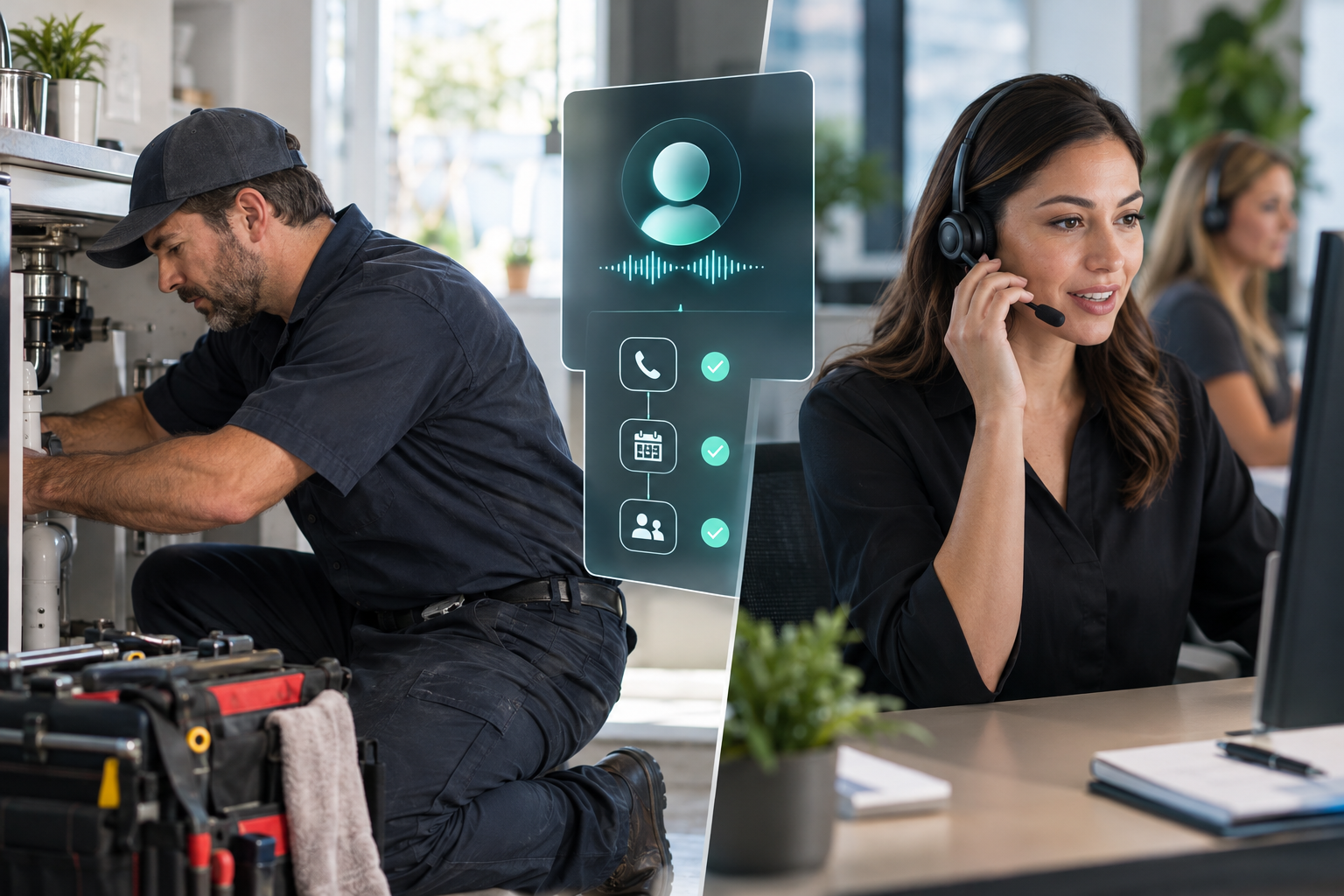
Every unanswered business call can become a lost appointment, an unhappy customer, or a lead who contacts the next company on Google. Traditional answering services have long helped businesses cover busy periods and after-hours calls, but AI voice technology now offers another option.
In an AI receptionist vs answering service comparison, neither choice is automatically better for every company. The right solution depends on your call volume, scheduling workflow, customer expectations, compliance requirements, and need for human judgment. This guide explains the practical differences so you can choose based on how your business actually operates.
AI Receptionist vs Answering Service: The Quick Answer
An AI receptionist is usually the better fit when you need immediate 24/7 response, consistent qualification, automated booking, and direct CRM updates. A traditional answering service may be better when calls regularly require empathy, nuanced judgment, complex explanations, or escalation to a trained person.
Many businesses benefit from a hybrid model. An AI phone agent can handle routine calls, collect information, book appointments, and route urgent requests, while a human team manages sensitive or unusual conversations.
The most important distinction is that an AI receptionist can do more than take a message. When properly configured, modern AI voice agents for call handling can answer common questions, follow qualification rules, schedule appointments, trigger follow-up, and transfer callers based on real-time conditions.
How Each Call-Handling Option Works
What is an AI receptionist?
An AI receptionist is a voice-based software agent that answers business calls and interacts with callers conversationally. It follows approved workflows and can connect with calendars, customer relationship management platforms, and other business systems.
Depending on its setup, an AI receptionist can:
- Answer calls during business hours, after hours, or around the clock
- Identify the caller’s reason for contacting the business
- Answer approved frequently asked questions
- Collect names, phone numbers, addresses, and service details
- Qualify leads using business-specific questions
- Book, reschedule, or request appointments
- Route urgent calls or transfer qualified prospects
- Create CRM records and trigger text or email follow-up
The quality of the customer experience depends heavily on implementation. The agent needs accurate information, natural scripts, clear escalation rules, and integrations that have been tested against real call scenarios.
What is a traditional answering service?
An answering service uses human agents to answer calls on behalf of a business. The agent typically follows a script, gathers contact information, takes a message, and contacts the appropriate employee. More advanced services may provide scheduling, lead intake, dispatch support, or industry-trained virtual receptionists.
Because people handle the conversations, answering services can adapt when callers are emotional, confused, or unable to explain their needs clearly. However, capabilities and consistency vary by provider, training level, staffing, and integration options.
AI Answering Service Comparison
| Decision factor | AI receptionist | Answering service |
|---|---|---|
| Availability | Can answer simultaneously and operate 24/7 when configured | Depends on staffing, plan, and operating hours |
| Response consistency | Uses the same approved rules on every call | May vary between agents and shifts |
| Human judgment | Limited to defined instructions and escalation logic | Stronger for ambiguous or sensitive conversations |
| Appointment booking | Can book directly through integrated calendars | May book directly or send a message for follow-up |
| CRM updates | Can automatically create records and trigger workflows | Often requires manual entry or provider-specific integrations |
| Scalability | Can manage multiple inbound calls without a conventional queue | Capacity depends on available agents |
| Quality control | Requires script, prompt, integration, and call-log reviews | Requires agent training and call-quality monitoring |
| Best use | Routine, repeatable, high-frequency workflows | Complex, emotional, or highly variable conversations |
When comparing a virtual receptionist vs AI, confirm what the provider means by “virtual receptionist.” Some companies use the term for remote human receptionists, while others use it for automated software. Ask who or what answers the call, which actions can be completed, and how callers reach a person.
When an AI Receptionist Is the Better Choice
An AI receptionist is well suited to businesses with repeatable call patterns. An HVAC company, for example, may need to collect the caller’s ZIP code, system type, symptoms, and preferred appointment time. A dental practice may want to separate new-patient inquiries from existing-patient scheduling requests. A law firm may need consistent intake questions without asking its legal team to answer every initial call.
AI is particularly useful when:
- Missed calls are common during jobs, appointments, or peak hours
- Most callers ask the same set of questions
- Speed to lead is important
- The business wants direct calendar or CRM updates
- Employees spend too much time handling routine requests
- Calls arrive after hours or in unpredictable bursts
The larger benefit comes from connecting the call to the rest of the customer journey. For example, a qualified caller can be entered into the CRM, sent an appointment confirmation, and placed into a reminder sequence. This turns reception into part of a broader done-for-you AI marketing automation system rather than an isolated call-answering tool.
When a Human Answering Service Is Better
A traditional answering service remains valuable when conversations cannot be reduced to clear, safe workflows. Callers contacting a law firm about a traumatic event, a dental practice about a complicated concern, or a home-service company during a stressful emergency may need patience and judgment beyond what an automated agent should provide.
Choose a human-first option when:
- Calls frequently involve distress, conflict, or sensitive personal circumstances
- The caller’s intent is difficult to categorize
- Every conversation requires specialized expertise
- Your customers strongly expect a person at the first point of contact
- Regulatory or internal policies require human review
A human service can also be a practical temporary choice when a company has not yet documented its call flows. AI works best when the business can define what should happen for each common request.
Practical Examples by Industry
Home services
A plumber or electrician can use an AI receptionist to gather the service address, describe the issue, identify whether immediate danger is present, and route the call according to approved emergency rules. The agent should never diagnose technical or safety problems beyond its authorized script.
Medspas and dental practices
An AI phone agent can answer general service questions, capture new-patient details, and request consultations. Medical questions, treatment advice, and urgent concerns should be transferred or escalated under a carefully approved policy.
Law firms
AI can conduct basic lead intake by collecting contact details, practice-area information, incident dates, and preferred consultation times. It should not offer legal advice or imply that submitting information creates an attorney-client relationship.
Marketing agencies and small businesses
Agencies can qualify prospects by service interest, budget range, timing, and decision-making status before booking a discovery call. Other small businesses can use the same approach to reduce interruptions while preserving a clear path to a human representative.
How to Evaluate Cost and ROI
Do not compare options using the monthly fee alone. Evaluate the entire workflow and the operational cost of missed opportunities, delayed follow-up, manual data entry, and employee interruptions.
Useful questions include:
- How many calls go unanswered or reach voicemail?
- How quickly are new callers contacted?
- How many routine calls require employee time?
- Can the solution book appointments or only take messages?
- Are usage, integrations, transfers, setup, and support included?
- What happens when the system cannot understand a caller?
- Can managers review call outcomes and improve the workflow?
For an accurate comparison, estimate the value of completed actions—not just answered calls. A system that books a qualified appointment and updates the CRM may provide more operational value than one that simply emails a message.
How to Implement an AI Receptionist Safely
- Map your call types. Review common reasons people call, including new leads, existing customers, vendors, emergencies, cancellations, and spam.
- Define permitted actions. Decide what the agent may answer, collect, schedule, transfer, or decline. Avoid allowing it to improvise professional, medical, legal, or technical advice.
- Create escalation rules. Specify what happens when a caller requests a person, becomes upset, reports an emergency, or asks an unsupported question.
- Connect essential systems. Integrate the correct calendar, CRM pipeline, notification workflow, and follow-up channels. Limit access to what the agent needs.
- Test realistic scenarios. Include background noise, interruptions, unusual names, repeat callers, vague requests, and calls outside your service area.
- Launch with oversight. Review transcripts, recordings where legally permitted, appointment accuracy, transfers, and failed interactions. Refine the workflow instead of treating launch as the final step.
Businesses should also review applicable federal and state requirements involving call recording, consent, privacy, marketing communications, and industry-specific data. The National Institute of Standards and Technology’s AI Risk Management Framework is a useful external resource for building responsible AI oversight, although businesses should obtain qualified legal guidance for their specific obligations.
Common Mistakes to Avoid
- Automating an undocumented process: If employees disagree about how calls should be handled, the AI will not fix the underlying confusion.
- Hiding the path to a person: Callers should have a reasonable escalation option when automation cannot help.
- Using generic scripts: Workflows should reflect your services, service area, hours, qualification criteria, and brand voice.
- Ignoring the CRM: Call handling without reliable tracking creates disconnected records and weak follow-up.
- Failing to monitor performance: Products, schedules, promotions, and customer questions change over time.
Which Option Should You Choose?
Choose an AI receptionist if most of your calls follow predictable patterns and you want faster response, direct booking, consistent intake, and automated follow-up. Choose an answering service if your calls demand substantial empathy, interpretation, or human discretion. Consider a hybrid setup if routine requests can be automated but sensitive conversations still need people.
The technology is only one piece of the decision. The strongest setup connects phone handling with your CRM, calendars, lead routing, reminders, and reporting. A provider offering integrated done-for-you growth systems can help prevent the receptionist from becoming another disconnected tool.
Frequently Asked Questions
Can an AI receptionist replace a human receptionist?
It can handle many repetitive tasks, but it should not replace human judgment in every situation. The best division of work depends on call complexity, customer expectations, and risk.
Can an AI phone agent book appointments?
Yes, when connected to a compatible scheduling system and configured with accurate availability, appointment types, durations, and booking rules.
Will callers know they are speaking with AI?
Disclosure practices vary by use case and jurisdiction. Clear, transparent introductions can set expectations and give callers an option to request human assistance.
Is an AI receptionist suitable for after-hours calls?
Yes. After-hours coverage is a common use case, especially for capturing leads, answering approved questions, requesting appointments, and escalating defined urgent situations.
What are the best answering service alternatives?
Alternatives include an AI receptionist, an in-house employee, a remote virtual receptionist, voicemail with automated follow-up, or a hybrid AI-and-human model. Compare completed actions, integrations, oversight, and customer experience—not merely whether the phone gets answered.
Build the Right Call-Handling Workflow
The AI receptionist vs answering service decision should start with your callers and business process. Document the calls you receive, decide which interactions can be standardized, and preserve human involvement where empathy or judgment matters. With the right workflow, your phone system can become a dependable part of lead capture, scheduling, and customer service rather than a source of missed opportunities.
Leave a Reply