
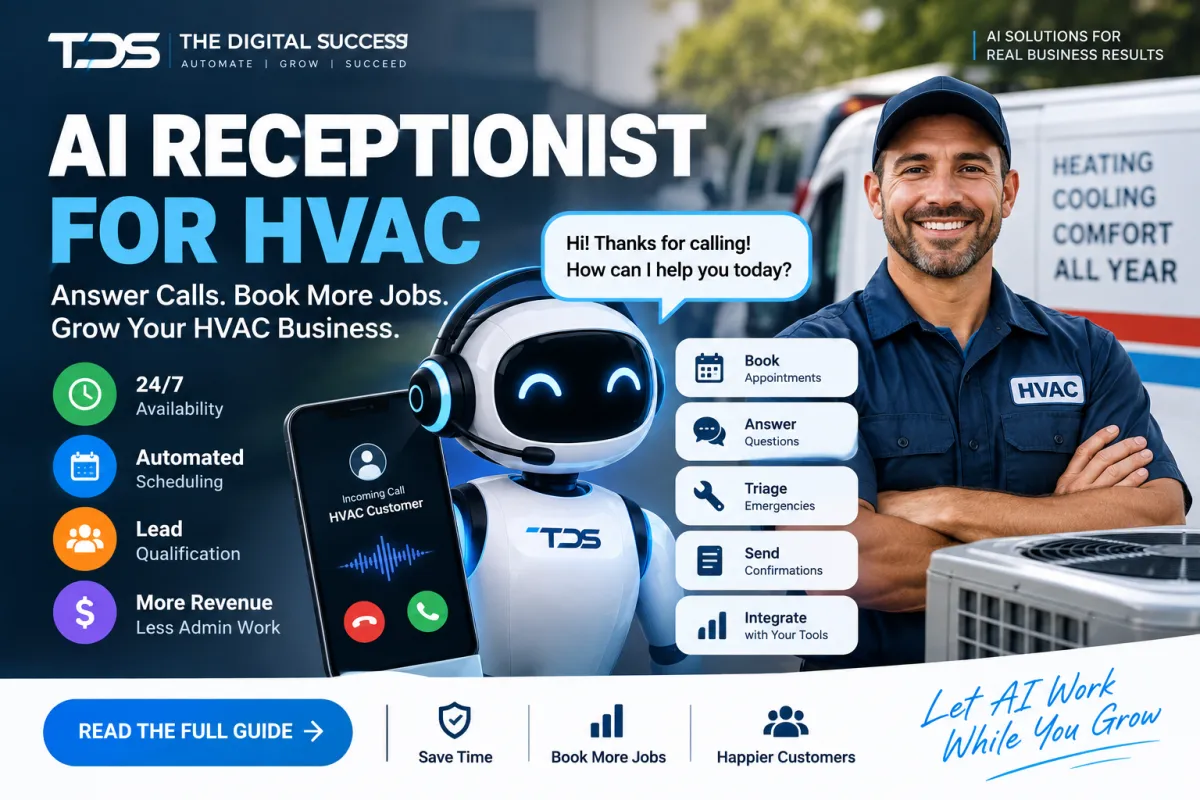
How an AI Receptionist for HVAC Can Transform Your Small Business
Running a small HVAC company means juggling service calls, scheduling, dispatch, and customer inquiries while trying to grow revenue. An AI receptionist for HVAC can take the load off your office team, improve response times, and turn more callers into paying customers. This article explains what an AI receptionist does, real-world examples you can use today, and practical steps to implement one without breaking your budget.
What is an AI receptionist and why it matters for HVAC businesses
An AI receptionist uses conversational AI and automation to handle calls, texts, and sometimes chat requests. For HVAC companies, that means answering routine questions, booking appointments, qualifying leads, and routing urgent calls to the right technician. Unlike traditional answering services, AI receptionists can operate 24/7, integrate with your scheduling software, and learn from interactions to improve over time.
Top benefits of an AI receptionist for HVAC
Always-on availability: Capture leads after hours and on weekends when many competitors are closed.
Faster response times: Customers get quick answers about pricing, availability, and emergency procedures.
More booked jobs: Intelligent booking flows reduce back-and-forth and convert more inquiries into appointments.
Lower admin costs: Free up office staff to focus on higher-value tasks like customer follow-up and upsells.
Consistent customer experience: Provide accurate, repeatable information on warranties, maintenance plans, and service windows.
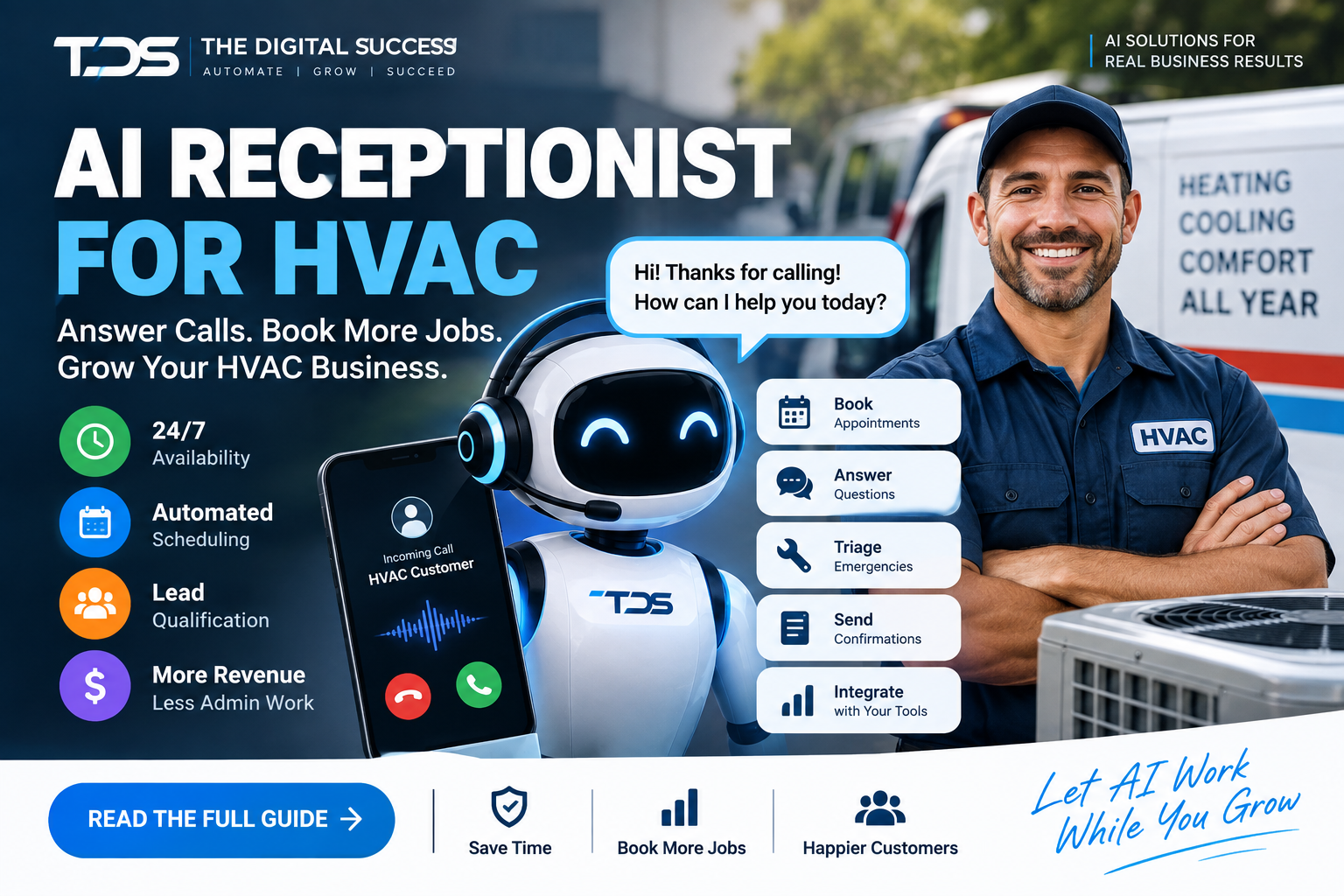
Practical examples: How HVAC companies use an AI receptionist
Example 1 — After-hours emergency triage
A homeowner texts or calls late at night saying their furnace stopped working. An AI receptionist can run a quick decision tree to determine if the issue is a safety emergency (like a gas smell) and advise shutting off equipment and calling emergency services, or schedule the earliest available dispatch. This protects customers and ensures urgent calls reach a live tech when necessary.
Example 2 — Automated appointment scheduling
Instead of leaving voicemails or bouncing emails, callers can pick a time from available slots shown via text or booked directly through the phone call. The AI checks your technicians' calendars, blocks time, and sends confirmations and reminders—reducing no-shows and double-bookings.
Example 3 — Lead qualification and upsell prompts
When a residential customer calls about an AC tune-up, the AI can ask a short set of qualifying questions (system age, last service date, symptoms). If the system is old, the AI can flag the lead as a replacement opportunity and prompt the agent or technician to discuss replacement options during the visit.
Example 4 — Multilingual and accessibility support
Many AI receptionists offer multilingual support and text-based options for hearing-impaired customers. That expands your reach in diverse communities and improves compliance and customer satisfaction.
Integrations and workflows that make sense for small HVAC shops
If you want more than just call answering, a done-for-you marketing automation system can connect your website, CRM, AI calling, lead nurturing, and appointment booking. Useful integrations include:
Scheduling software (Google Calendar, Housecall Pro, Jobber)
CRM systems to store lead data and service history
SMS gateways for appointment reminders and confirmations
VoIP phone systems so calls route cleanly between AI and human staff
Set up simple workflows: route new service calls to a lead queue, have the AI book routine maintenance automatically, and escalate suspected emergencies to on-call technicians with a single human confirmation.
How to implement an AI receptionist without disrupting operations
Start small: Begin with after-hours answering and appointment scheduling, then expand to lead qualification.
Train the system: Feed common scripts, FAQs, and responses so the AI sounds like your brand.
Monitor and refine: Review call transcripts weekly for the first month to correct misunderstandings and optimize prompts.
Keep a human fallback: Ensure callers can reach a live person for complex issues—AI should augment, not replace, human judgment.
Cost considerations and ROI
Pricing varies—monthly subscriptions often start as low as the cost of a part-time receptionist and scale with call volume and features. Calculate ROI by tracking metrics like calls answered, appointments booked, no-shows reduced, and time saved by staff. Many HVAC owners find the system pays for itself within months by capturing after-hours leads and improving booking efficiency.
Security and compliance
Choose vendors that encrypt voice and text data, offer secure access controls, and comply with local privacy laws. Maintain minimal data retention policies for sensitive customer information and make sure staff know how to handle escalations that involve personal data.
FAQ
Will an AI receptionist handle complex technical questions?
An AI receptionist handles common questions and triage. For complex diagnostics, it should route the caller to a trained technician or schedule a service visit. You can program the AI to collect helpful details to speed up the technician's assessment.
Can the AI integrate with my current scheduling software?
Most modern AI receptionists integrate with popular scheduling and CRM platforms. Before purchasing, confirm the vendor supports your software or offers API access for custom connections.
How do customers react to talking with AI?
Many customers appreciate quick responses and easy booking. Provide an option to reach a human, and make sure the AI uses friendly, natural language—this reduces friction and builds trust.
Is it expensive to get started?
Costs vary, but many providers offer tiered plans and trials. Compare features like 24/7 coverage, speech-to-text accuracy, and integrations to find the best value. Consider the time savings and extra bookings when evaluating costs.
Next steps for HVAC owners
Start by listing the top three tasks your front desk handles today. Pilot an AI receptionist to take over one task—like after-hours calls—and measure results. Use call data to refine scripts, then expand to scheduling and lead qualification. With a phased approach, an AI receptionist for HVAC can become a reliable teammate that grows your business without adding payroll expenses.
Want help choosing the right solution? Contact a technology partner who understands HVAC operations and can tailor an AI receptionist to your workflow.


